

EU hits Elon Musk’s X with $140 million fine over business practices - NPR
EU hits Elon Musk’s X with $140 million fine over business practicesNPR...

--- title: EU hits Elon Musk's X with $140 million fine over business practices author: Willem Marx url: https://www.npr.org/2025/12/05/nx-s1-5634694/x-musk-eu-fines hostname: npr.org description: The fines were due to the platform's misleading use of blue check marks to identify verified users and a lack of transparency over ads and data access for researchers. sitename: NPR date: 2025-12-05 tags: ['European Union', 'Twitter'] --- # EU hits Elon Musk's X with $140 million fine over business practices
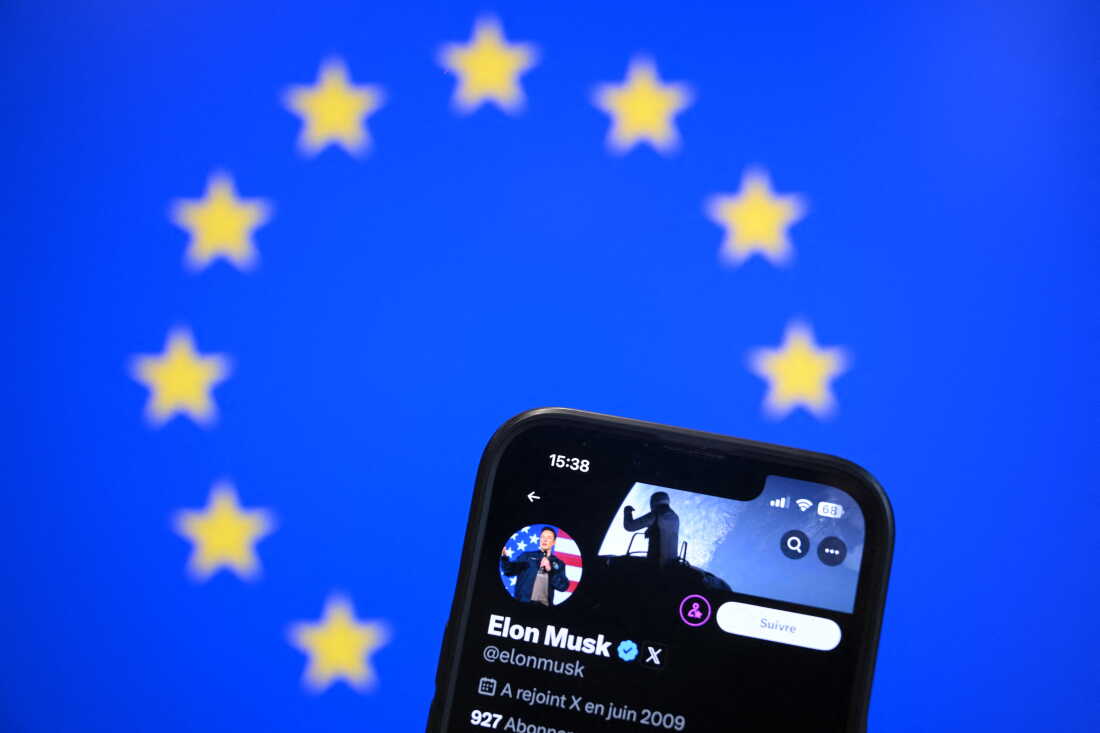
The fines were for violations including what the EU calls a misleading use of the blue check mark on users' profiles. ** Nicolas Tucat/AFP via Getty Images ** **hide caption**
**toggle caption**The European Union has announced a fine of $140 million against Elon Musk's X, the social media platform formerly known as Twitter, for several failures to comply with rules governing large digital platforms. A European Commission spokesperson said the fine against X's holding company was due to the __platform's misleading use of a blue check mark__ to identify verified users, a poorly functioning advertising repository, and a failure to provide effective data access for researchers.
Europe's preference had not been to fine X, said the spokesperson, Thomas Regnier, as he drew a contrast with the Chinese-owned platform TikTok. Regnier announced Friday that TikTok had separately offered concessions that would allow it to avoid such penalties.
"If you engage constructively with the Commission, we settle cases," Regnier said at a press conference in Brussels. "If you do not, we take action."
The possibility that X would face financial penalties in Europe had drawn significant political fire, not only from Musk but also from others in Washington, D.C., over the past two years since the European Commission __began its investigation__.
"Rumors swirling that the EU commission will fine X hundreds of millions of dollars for not engaging in censorship," Vice President Vance __wrote__ on X Thursday. "The EU should be supporting free speech not attacking American companies over garbage."
In July 2024, in a __set of preliminary findings__, the European Commission formally accused X — which serves more than 100 million users within the EU — of several violations. These included its failure to meet transparency mandates, obstructing researchers' access to data, and misleading users by converting the blue verification badge into a paid subscription feature.
Musk has long __stated his intention to legally challenge__ any EU sanctions, rather than make concessions to resolve the investigation.
Nonetheless, the company could have faced far higher financial penalties, with European authorities able under new legislation — known as the __Digital Services Act__ — to fine offenders 6% of their worldwide annual revenue, which in this case could have included several other of Musk's companies, including SpaceX.
The fine announcement follows months of __accusations__ from activists and trade experts that authorities in Brussels were deliberately easing up on enforcement to appease Trump. Musk was a prominent supporter of Trump's campaign and spent several months this past spring serving as an administration adviser and the public face of the Department of Government Efficiency initiative.
The willingness to take on Musk's business empire could serve as a critical test of the EU's determination, especially in light of President Trump's previous threats of tariffs over the bloc's fines against U.S. technology giants.
The confrontation highlights a growing division over the concept of digital sovereignty, which has transformed long-standing allies into competitors as Europe strives to establish itself as the global authority for digital regulation, and the Trump administration pushes back against perceived curbs on U.S. companies' profits and freedom of expression.
So, experts warn, this direct punitive action against Musk's businesses carries the risk of U.S. retaliation, even though the EU remains heavily dependent on American technology for a range of sectors.
The United States is already leveraging some of these concerns about free speech as grounds for __denying U.S. visas to certain individuals__.
The Trump administration has also consistently argued that the EU unfairly targets U.S. technology companies with severe financial penalties and burdensome regulations, equating these measures to tariffs that justify trade retaliation. Just last week, U.S. Commerce Secretary Howard Lutnick stated that the EU must revise its digital regulations to secure a deal aimed at reducing steel and aluminum tariffs.
The Commission denied again Friday any connection between the trade negotiations with the U.S. and the implementation of its technology rulebooks, any targeting of American firms or any kind of infringement on freedom of expression.
"Our digital legislation has nothing to do with censorship," said Commission spokesperson Regnier. "We adopt the final decision, not targeting anyone, not targeting any company, not targeting any jurisdictions based on their color or their country of origin."
Despite the Trump administration's pressure, the EU has proceeded with the enforcement of its digital antitrust rules, __recently imposing fines__ of $584 million on Apple Inc. and $233 million on Meta Platforms Inc.
It has also issued substantial penalties against other corporations, including over $8 billion total in fines against Alphabet Inc.'s Google over several years, and a separate directive for __Apple to repay €13 billion__ in back taxes to Ireland for providing unfair state aid.
Other potentially more serious __concerns about X's management of illegal content__, election-related misinformation, and the __utilization of Community Notes__ have not yet progressed to the preliminary stage in a separate investigation by the European Commission.