

Week 14 Fantasy Football: Players trending toward more targets - PFF
Week 14 Fantasy Football: Players trending toward more targetsPFF...

- Get PFF+ for 30% off:Use promo codeHOLIDAY30to unlock the PFF Player Prop Tool, Premium Stats, fantasy dashboards, the PFF Mock Draft Simulator, industry-leading fantasy rankings and much more — everything you need to win your season.

Last year, I introduced a new framework for understanding wide receiver play, quarterback decision-making and offensive potential. This framework relies on an XGBOOST model and PFF’s impressive collection of route-level data. Using machine learning and this breadth of PFF data, we can create models with the goal of predicting where a targetshouldgo on a given play.
The resulting metrics,Share of Predicted Targets and Share of Predicted Air Yards, are both more stable than their “actual” counterparts.
### Week 13 Recap
- D.K. Metcalf: 5 targets – 22.73% target share
- MalikWashington: 5 targets – 25.00% target share
- Dalton Schultz: 8 targets – 25.00% target share
- Jordan Addison: 10 targets – 34.48% target share
- Alec Pierce: 5 targets – 20.00% target share
- Van Jefferson: 4 targets – 11.43% target share
- Chris Moore: 0 targets – 0% target share
### Potential Breakouts: Week 14
These are players who were open far more often than they were targeted in Week 13. In general, players who show up on this list see an uptick in targets per route run and target share relative to both themselves and all players with similar target shares.
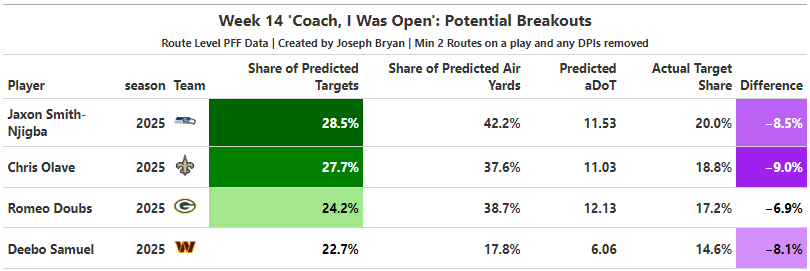
After a season-low four-target, 23-yard performance,Jaxon Smith-Njigbamakes the list for the first time this season. He matches up against theAtlanta Falconsthis week in what should be a great bounce-back spot.
All four players this week are fairly big names who could see a bump in their target shares and even score a touchdown.
### Recent Leaders in Share of Predicted Targets
I wanted to take a moment to look at Weeks 10-13 and the leaders for the engine of the “Coach, I Was Open” model, share of predicted targets.As we have previously discussed, throwing to players that the Predicted Targets Model highlights creates better potential EPA outcomes for the entire offense. When the quarterback throws it to sub-optimal choices, the entire offense suffers, and we see far more negative EPA outcomes.
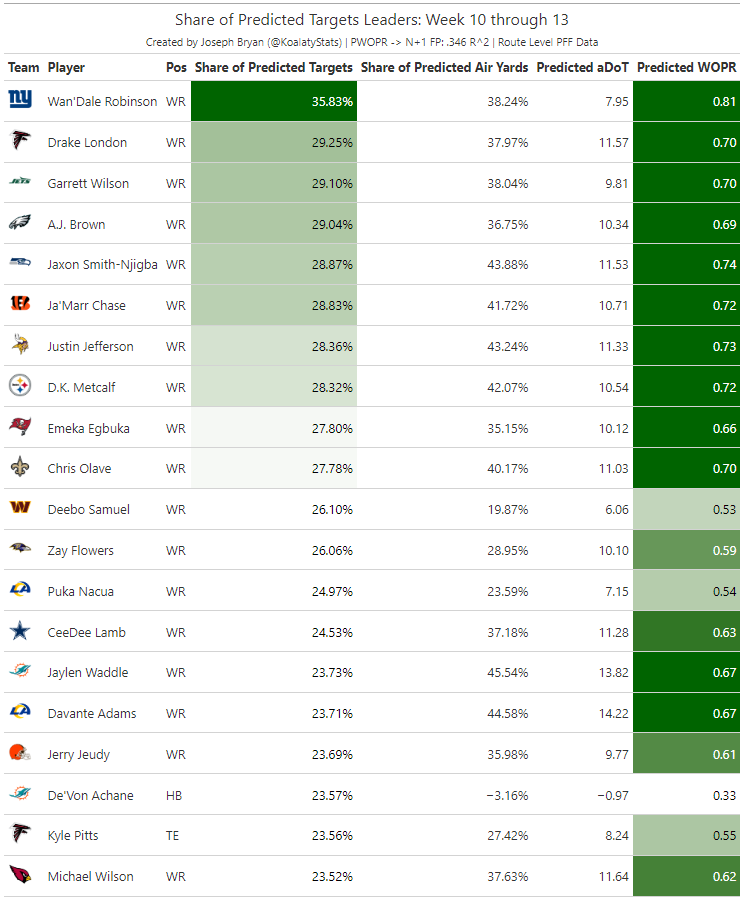
Wan’DaleRobinsonleads the league in share of predicted targets over the past month and, not coincidentally, also paces the NFL in actual target share over that span (35.29%). We saw his ceiling two weeks ago against theDetroit Lionsin a man-coverage heavy game withJameis Winstonat quarterback. In a less pass-centric offense withJaxson Dartunder center, that performance is unlikely to repeat itself, but Robinson’s ability to get open remains elite.
The best tight end over the last month in this metric has beenKyle Pitts. Given his superb and consistent share of predicted targets,Kirk Cousinsmight just be what Pitts needed this season to unlock his full potential. Consider that in games where Michael Penix Jr. started, Pitts had a 19.56% target share compared to a 27.16% target share with Cousins.
Over the season,A.J.Brown’s share of predicted targets has risen substantially, overtakingDeVonta Smithafter Smith led for most of the year. Brown now tops thePhiladelphia Eaglesin both share of predicted targets and actual target share.Per Timo Riske’s weekly statistical review, theEagles’ remaining schedule features strong offenses and weaker defenses, a favorable setup for continued passing volume and more targets for Brown.
### Week 13 “Coach, I Was Open’ Review”
This week, I wanted to take a look at what could have been the biggest play of the week for any offense.
TheLas Vegas Raiderstrailed 7-0 with 7:54 left in the second quarter, backed up at their own 3-yard line.Geno Smith, who holds a season-long 58.4 PFF passing grade (fourth-worst), took the snap, pump-faked to the left and settled behind a relatively clean pocket with time to work through his reads.
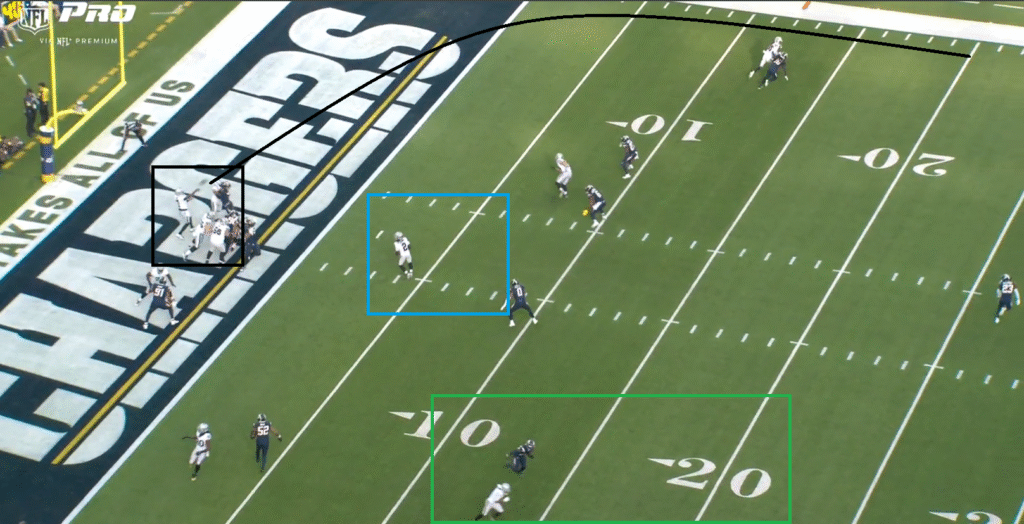
Dont’e Thornton Jr.failed to separate on a back-shoulder go, whileTre Tuckergained clear separation on a go route to the opposite side. On the play, Thornton was the only receiver charted with no separation of any kind and the lone player to earn a negative play-level PFF grade. Meanwhile, Tucker received a +1 play-level grade and posted a week-leading 2.31 predicted EPA.
If Smith had looked off the free safety and delivered the ball accurately to Tucker, the result was likely a 97-yard touchdown and a tie game. Instead, he forced the throw to Thornton, the ball was tipped andTony Jeffersonintercepted it. That outcome produced the largest gap between predicted and actual EPA in Week 13.